


Jeff Gardiner




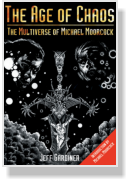
The Age of Chaos: The Multiverse of Michael Moorcock (BFS, 2002).
Intro by Moorcock: “Jeff Gardiner’s excellent book has offered me many fresh insights into my work”.
Published Articles
Gates of Elysium – monthly articles for The Alien Online Website 2003-4
- also translated into German for ‘Alien Contact’ and in the 2004 Yearbook.
Regular feature writer and reviewer for ‘Prism’ magazine from Spring 2003-5.
‘Francis Stevens: the Godmother of Fantasy’ in ‘Wormwood’ #2, 2004
‘Algernon Blackwood: Some Dark Ancestral Sense’ in ‘Wormwood’ #5, 2005
‘David Lindsay: Speculative Metaphysics’ in Wormwood #9, 2007
Various articles in Vector and Matrix magazines for BSFA 2003-4.
‘Nomads of the Slipstream’: Subtle Edens: The Elastic Book of Slipstream
Articles accepted for Estronomicon eZine - www.screamingdreams.com, 2010
Jeff Gardiner Author Interview in Midnight Street 14, November 2010
© Blood Design 2014





This is a well-written overview of Michael Moorcock's complete works, published by the British Fantasy
Society with an introduction by Moorcock himself. Moorcock has written hundreds of books, so covering
them all in under 120pp is obviously going to leave some underserved.
Although the chapters on Moorcock's early and later periods are detailed and fascinating, the heroic
fantasy for which he's still best known gets extremely short shrift (quite oddly, given the publisher), being
crammed into one nine-page chapter. There's little room for anything more than brief summaries of Elric,
Hawkmoon, Corum and the rest. The complete chapter given over to Gloriana, in contrast, seems
extremely generous. Nevertheless, this is an ideal book for anyone looking to get a quick critical grasp on
Moorcock. The lack of footnotes may limit its academic usefulness, but a useful reading list is provided.
The discussion of Behold the Man contains a couple of odd comments (apparently "Moorcock does not
deny the truth of the crucifixion") but is still very illuminating. It was a perfect book for me: in my twenties
I read everything I could that Moorcock had published up till then; now a new pile of his books has
accumulated and I find myself a little daunted. Reading The Age of Chaos has left me primed to have a
crack at the pile; recurring themes, characters and in-jokes have been dislodged from my memories and
reactivated.
On the other hand, will that help me enjoy Moorcock's new books? It's the critic's job to trace the
connections between an author's various works, to identify the themes and preoccupations, and Gardiner
does an excellent job of that. But these books are already awfully interconnected; they lock together like
chainmail. By stressing the connections this book gives an impression of sameiness and repetition. But
maybe it's just me, an impression I was left with after reading far too many of them all at once a long time
ago, an impression revived by this book, but not derived from it. After all, reading Gardiner's description
of The City in the Autumn Stars, I didn't recognise a thing: my overwhelming memory is of thinking, right,
there's Tanelorn, there's Jerry, there's Von Bek, and so on.
Gardiner's account has tempted me to re-read it: it's entirely possible that I read it as a fan, looking for
the things that fans look out for, rather than paying attention to everything that was new. Still, I'm probably
not alone in thinking Moorcock's books would benefit from being pushed apart a little bit. When I first read
most of them they were short, easily digestible books. Then some began to be collected in omnibuses.
And then they were all gathered together into a fourteen volume series of gigantic paperbacks. While I
appreciated the value for money, it felt as if they were being drawn closer and closer together, like the
stars at the end of the universe. The Knight of the Swords, The King of the Swords, The Sword and the
Stallion and The Hollow Lands were all winners of BFAs for best novel, but now they are permanently
reduced to chunks of larger volumes. Even an important literary novel of ordinary length like A Cure for
Cancer is only available as part of an omnibus, which is utter madness. (Shouldn't it be a Penguin
Modern Classic by now?) These books could really do with being treated as individuals again, given
some room to develop separate identities. Maybe if ebooks take off and economies of scale stop being so
all-important, that will happen.
Stepher Theaker
Theaker's Quarterly Fiction #27
Silver Age Books Spring 2009